

Does Vanderbilt Do Non Hysterectomy Surgery To Repair The Uterus Prolapse?
Pelvic Prolapse Repair
For many women, prolapse tin can include descent of the uterus, vagina, bladder and/or rectum resulting in a "bulging" sensation inside the vagina. In some cases, frank protrusion of these organs tin can occur. Pelvic organ prolapse can effect in symptoms including urinary leakage, constipation, and difficulty with intercourse.
Laparoscopic colposuspension is a minimally invasive surgical technique that provides a safety and durable method for reconstruction of the pelvic floor and its contents without the need for a big abdominal incision.
The Surgery
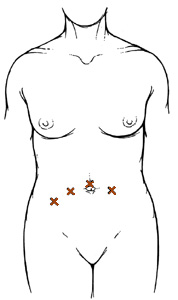
Laparoscopic colposuspension is performed using fine laparoscopic instrumentation inserted through 4 keyhole incisions across the mid abdomen (Figure 1).
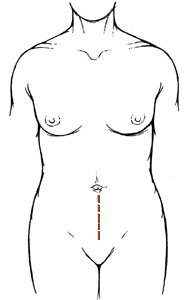
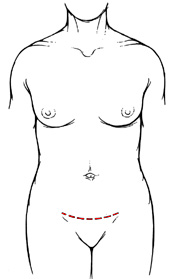
This is in dissimilarity to the conventional open abdominal colposuspension where a lower midline (Figure 2a) or Pfannenstiel (Figure 2b) intestinal incision is required.
In cases of pelvic organ prolapse, at that place is laxity of vaginal back up resulting in protrusion of the pelvic organs. The goal of laparoscopic colposuspension is to resuspend the vagina and associated pelvic organs through the key-pigsty incisions. In certain circumstances, a simultaneous hysterectomy, float suspension, or rectocele repair may be required, all of which can be accomplished through a vaginal arroyo.
Laparoscopic colposuspension is a well established process at Johns Hopkins Bayview Medical Center and is performed with the assistance of an experienced and dedicated laparoscopic surgical team including nurses, anesthesiologists, operating room technicians, many of whom you volition run across the twenty-four hour period of surgery.
Laparoscopic colposuspension is performed through four small-scale keyhole (0.v-1 cm) incisions beyond the mid abdomen (Effigy 1). Through these small incisions, fine laparoscopic instruments are inserted to dissect and suture. Excellent visualization of the pelvic organs is achieved with the use of a high-powered telescopic lens attached to a camera device, which is inserted into one of the keyhole incisions.
The vagina and pelvic organs are then resuspended internally with a combination of sutures and a supportive mesh or fascial graft (Figure 3). If needed, a bladder suspension, vaginal hysterectomy, and rectocele repair tin can be accomplished at the same fourth dimension via a vaginal incision. A Foley catheter (i.e. float catheter) is placed to drain the bladder. A gauze vaginal packing is likewise placed at the end of the procedure.
The length of operative time for laparoscopic colposuspension can vary greatly (3-5 hours) from patient to patient depending on the internal anatomy, shape of the pelvis, weight of the patient, and presence of scarring or inflammation in the pelvis due to infection or prior abdominal/pelvic surgery.
Claret loss during laparoscopic colposuspension is routinely less than 200 cc and transfusions are rarely required.
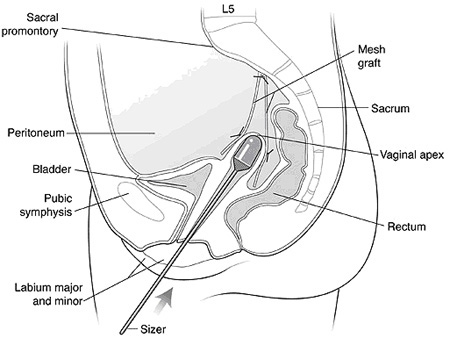
Effigy three. Schematic sagittal view of laparoscopic colposuspension with mesh graft.
Potential Risks and Complications
Although laparoscopic colposuspension has proven to exist very condom, equally in any surgical procedure at that place are risks and potential complications. Potential risks include:
-
Bleeding: Although blood loss during this process is relatively low compared to open up surgery, a transfusion may notwithstanding be required if deemed necessary either during the operation or afterwards during the postoperative menses.
-
Infection: All patients are treated with intravenous antibiotics, prior to the showtime of surgery to decrease the chance of infection from occurring within the urinary tract or at the incision sites.
-
Adjacent Tissue / Organ Injury: Although uncommon, possible injury to surrounding tissue and organs including bowel, vascular structures, pelvic musculature, and nerves could crave further procedures. Transient injury to nerves or muscles can likewise occur related to patient positioning during the performance.
-
Hernia: Hernias at the incision sites rarely occur since all keyhole incisions are closed under direct laparoscopic view.
-
Conversion to Open Surgery: The surgical process may crave conversion to the standard open operation if farthermost difficulty is encountered during the laparoscopic procedure (e.g. excess scarring or bleeding). This could result in a standard open up incision and peradventure a longer recuperation period.
-
Urinary Incontinence: Pre-existing urinary incontinence will typically exist addressed at the time of surgery with a bladder sling interruption, nonetheless, minor incontinence may still exist, which typically resolves with time. On occasion, medication may be required.
-
Urinary Retentiveness: As with urinary incontinence, postoperative urinary retentivity is uncommon and usually is present in patients who undergo concurrent bladder sling suspension. Temporary intermittent cocky-catheterization may be required postoperatively.
-
Vesicovaginal fistula: A fistula (abnormal connection) between the float and vagina is a rare complexity of whatever pelvic surgery involving the vagina, uterus, and bladder. A vesicovaginal fistula typically manifests with symptoms of continuous urinary leakage from the vagina. Although rare, these fistulas tin can exist managed conservatively or by surgical repair through an vaginal incision.

Source: https://www.hopkinsmedicine.org/health/treatment-tests-and-therapies/pelvic-floor-repair
Posted by: harrismitte1993.blogspot.com
0 Response to "Does Vanderbilt Do Non Hysterectomy Surgery To Repair The Uterus Prolapse?"
Post a Comment